bkh1914 wrote:
Black, White are special colors: the absence of all color (Black) and the maximum presence of all colors (White). They live in the center and edge of a shaded color wheel. They have no hue value, although for convenience GIMP assigns them a hue of 0. Changing the position of the hue slider has no effect on the resulting color.
Gray is all the shades between Black and White. Like Black and White, Gray has no hue because all the colors are equally present. For example 50% gray (neutral gray) is the combination of 50% red, 50% green and 50% blue (RGB color system). Inverting a gray color produces the complimentary gray color: 30% Gray (70% White) inverts to 70% Gray (30% White).
I hope this helps, rather than adding to the confusion.
The color wheel is such a basic concept in art that it is well worth a little time to learn it and understand it.
Note: the color wheel for pigments is different from the color wheel for light (i.e. digital art).
Actually, the "invert" function doesn't care about the HSV values at all, because it works strictly on RGB space. What I'm saying is, your explanation is basically correct, but I think you're explaining it in a sort of roundabout way...
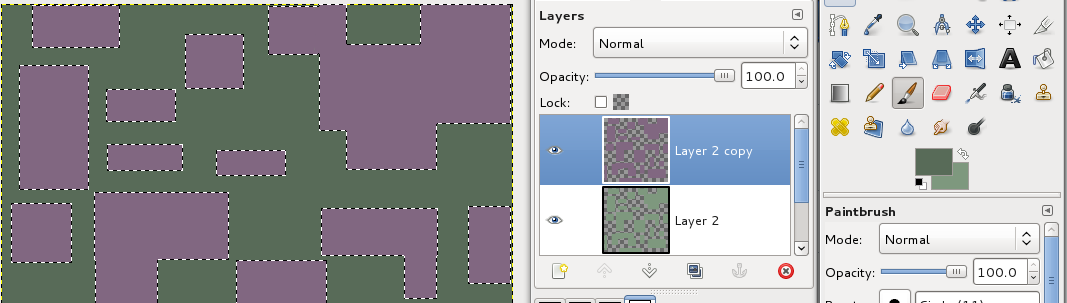
Invert simply inverts each colour channel R, G, B to their inverse values, ie. they are substracted from 255 so that for example (0,255,0) becomes (255,0,255) and so on. A channel value of 100 would become (255 - 100 = 155).
The reason why invert works differently on black, white or any grayscale colour is because in grayscale colours (ie. colours where saturation is 0) all the RGB values are the same, eg. black is (0,0,0), white is (255,255,255) and middle gray is (128,128,128)... so when they're all inverted, they'll again all be the same, resulting in another grayscale value.
A saturated colour ends up with the complementary colour (ie. 180 degrees on the colour wheel) because of the way HSV is mapped on the RGB space. Saturation and Value do not necessarily stay the same, though.
"Value invert", on the other hand, does work on the HSV space, as the name implies - it converts each colour to HSV space, then inverts the Value, keeping H&S the same, and then converts it back to RGB.
 Login
Login Register
 Tweets
 FAQ
FAQ Advanced Search







 .
.