@oldmangrumpy
Not bad, portrait painting is challenging but rewarding! I like that you are mixing up the subjects - different complexions, skin colors etc. Painting dark skin is quite different from pale/white skin due to how the blood capillaries appear through the top layer of skin.
Since you are looking for constructive feedback: One thing to try (taking the latest image as an example) is to mix in some 'unexpected' colors in your skin. Skin is not beige, sticking to that hue tends to give a less-lively feel to the skin. Think of skin as a thin, semi-transparent sheet on top of something that is essentially different hues of red. In multiple places on the face, the skull is closer or further away from the skin, with more muscle and blood in between. This changes the hues.
Here is an example of pale skin - the cheek of a jolly Santa:
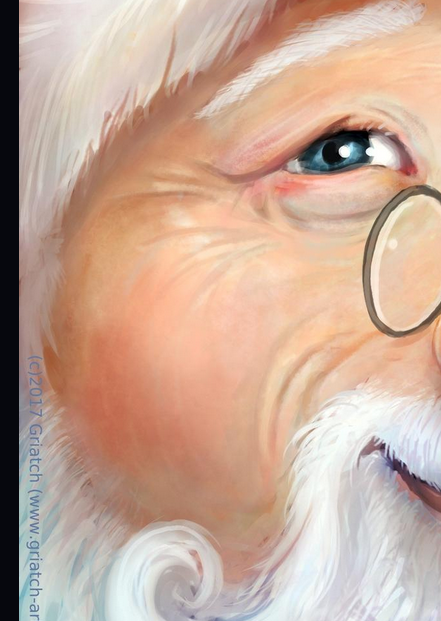
Note how the skin has red undertones (a little extra since it's Santa) but also other non-beige colours, like hints of blue, purple and even hints of green. After laying out the base structure of the skin, it can be useful to take a pass with these 'weird' colors using a low-opacity brush and then use smudgel/blend to work them into the skin. Even without being overly careful about the anatomic details you can make the skin feel more 'lively' by just breaking up the colors a bit.
Dark skin modifies the hues quite differently, and there are of course also different 'darkness' to consider. Here is an example of dark skin without much of an external light source:
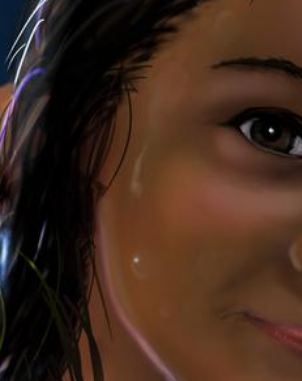
Note that even though the skin itself is dark, there is still red/pink underneath it, especially at the cheeks (this person has high cheek-bones). Also here are nuances of purple and green mixed into the skin, even though less obviously so. This is also an example of skin that is 'smooth' and with few blemishes (which is also possible for younger people) although most people will have more irregularities in their skin.
Keep up your portrait-painting, always good to see people trying out new things.

.
Griatch
 Login
Login Register
 Tweets
 FAQ
FAQ Advanced Search