Odinbc wrote:
Hey Wallace, how do like this one?

I've done my fair share of " tank drifting" during the winter,
while stationed in Germany as well as here in the states.
That's 62 metric tons of tank skidding across the road.
I once witnessed a tank during one winter in Germany.
Take out an entire barn and half a house,
because of icy conditions and not having ice cleats installed.
If the tank is outfitted with "ice cleats", that doesn't happen.
Unless it's done on purpose by the driver.
Tanks uses rubber pads on the track to provide traction and reduce track noise,
but under icy road conditions in hilly terrain,
the rubber pads on the track loose traction,
just like automobile tires loose traction on snow and ice in winter.
On your car, you install tire chains in winter.
The Army uses "ice cleats" on the track to give more "bite"
and to provide traction on icy, hilly roads and terrain.
The "ice cleats" are steel plates with an X-shaped cleat extending out from the base.
They are substituted for the rubber pads on every fifth shoe on the tank track.
Each tank uses two sets of 32 ice cleats for winter traction.
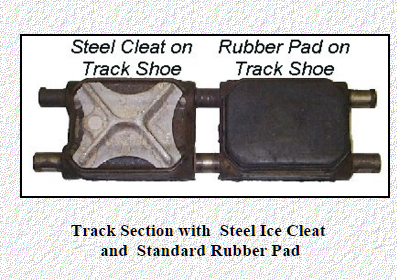
A single ice cleat weighs approximately 8 pounds and has a footprint of 6" x 7" and a height of 2".
It's bolted to the track shoe using the same mounting system used for the rubber pads.
The current ice cleat design calls for a heat-treated forging made from 4140 or 4340 steel alloy
for high strength and toughness to survive road abrasion and impact at sub-zero temperatures.
The finished cleat requires dimensional tolerances on the order of 0.06" to fit snugly into the track shoe.
The only machining requirements are a drilled and tapped hole for the mounting stud
and 3 milled locator pads on the flat face of the cleat.
Looks like some of the tanks in that clip didn't have the ice cleats on,
or at least not a full complement of them.
Often times we never installed them anyway, due to time constraints.
 Login
Login Register
 Tweets
 FAQ
FAQ Advanced Search



 Video from :