@Molly
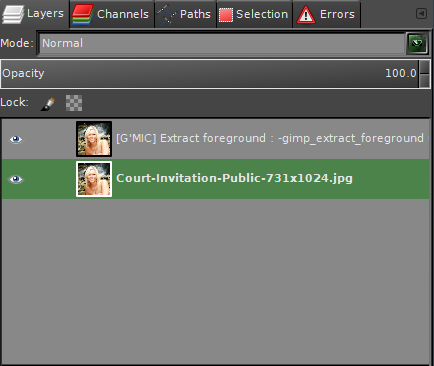
Using the code pulled from git @ Sat Sep 13 23:38:06 2014 +0200
Image using a mask purely generated by Contours->Foreground extraction:

For comparison, a composite mask where hair masking came from a high contrast, luminance channel:

This is the hinting pattern fed to Foreground extract:

Ah. I suppose I should touch upon cheating.
In both cases, I did not work at size, but on 5X images, as is my wont in all masking work, and since my interest centered on a principle edge, I did not wish to confuse the extraction tool (or myself) with irrelevant detail, so I suppressed interior features where it was easy to do with a quick plotting using the lasso tool, and then blurring irrelevant features into uniform obscurity.
I think with this tool, working oversize is mandatory, not just for the increased dexterity in plotting hints, but also the nature of watershed algorithms, which depend on connectivity - think flood fill or flood select tools - which try to join as many pixels of a particular character as possible without crossing over or including pixels of a different character. That is an intrinsically difficult problem with like pixels forming single pixel wide regions and joining at corners. Are two pixels touching at a corner, but otherwise disjoint, forming one region or two? You can argue both ways, making you a High Connectedness Fellow if you think one region, otherwise a Low Connectedness Fellow if you think two. Better to rise above the debate by enlarging the image five- or ten-fold.
Hair challenges this and any automated masking tool. I think Molly provided a nice test case because the depth of field was only narrow enough to keep the girl's face in focus; her hairstrands were already slightly out of focus and bleeding into the green vegetation behind her. Specular flares here but not there, slightly translucent hair also picking up green here, but not there. Single hair strands wisping off, disappearing and reappearing as the play of light changed. Watershed algorithms like to decide if a pixel is in this basin or that basin, so by nature tend to produce hard-edge masks. Hair looks terrible with hard edged masks - especially slightly de-focussed hair - but hard-edge masks make definite edges seem better.
So at the end of a day, it comes down to the same question of tirage. How much can I get away with an automated mask that, maybe gets me more than half the way home? I'd be happier still if it takes me two thirds of the way home, less happy if it only takes me a third of the way home, but, in any case, I'm happier than if I had to work the entire mask by hand.
For that reason, I'm very glad the tool is here, for however far it can carry me, and it is an interesting enough technical problem to keep a fair number of programmers busy. I think David has bought it along quite a ways, but Molly is right when she says there is quite a ways still to go.
GRO
 Login
Login Register
 Tweets
 FAQ
FAQ Advanced Search











 Video from :