rich2005 wrote:
The colormap editing method, is rarely so trivial. A more usual case is a 256 colormap with very similar colours.
Try this one.
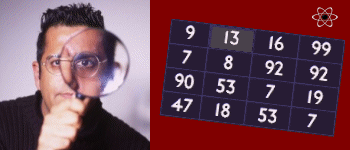
http://www.eclectic-penguin.org.uk/cach ... ection.gifOne way to proceed with these (apart from trial and error) is to dump the colormap as a hex table and either search or sort to find matches.
That sounds like the hard way of doing it!
You can usually expose any
colourmap redundancy (which is what this method is using) by simply swapping the colourmap (ie. Colours> Map> Set colourmap...) for something completely different.
For images with a small colourmap (up to 16 colours) such as the images posted by Rich and Ofnuts above, simply setting the colourmap to the standard "EGA" should be enough to show you what's there (if anything). Of course, the colours will all be wrong, but that doesn't really matter.
For images with larger colourmaps (up to 256 colours), try "EGA" first, then also try the standard "Gold" colourmap - that will usually expose anything not shown by "EGA" because the "Gold" colourmap is in fact just a very gradual gradient from pale-yellow to near-black, and since the colourmap actually used in indexed images is usually nothing like a very gradual gradient, the redunancy will stand out.
You can also make your own completely-different-yet-again colourmap, eg. using the "plasma" texture generator:
File> New> 400x400
Filters> Render> Clouds> Plasma... (Random seed = 0)
Image> Translate into palette... (save as "Plasma")
This will generate a new palette (which you can then use as a colourmap) with lots of bright colours but in a completely random order, quite different from the standard colourmaps (such as "EGA" and "Gold").
So, if "EGA" and "Gold" don't expose anything, "Plasma" probably will.
(For a more comprehensive technique, rather than manually searching a hex dump of the colourmap, I would suggest writing a Python script to highlight any redundancy.)
 Login
Login Register
 Tweets
 FAQ
FAQ Advanced Search



 ).
).