First the good news.

Proof of concept works, this method does in fact improve your odds if the machine/lottery balls combination is flawed in their probability distribution.
I have create a test page (called "theoryTest.html") which takes a file ("theoryTest.txt") with entries that define a number followed by frequency of occurrences on each line to define a probability model. You can download these files and change the theoryTest.txt file with different numbers or frequencies to test for yourself.
Attachment:
 lotto.zip [15.58 KiB]
Downloaded 108 times
lotto.zip [15.58 KiB]
Downloaded 108 times
For proof of concept I am only making it selecting 2 numbers (instead of 6 or 7 for 6/49, lottoMax respectively).
I make it quick pick 2 numbers based on probability model (defined by input file) (let's call this probabilityModelQuickPick).
select a random result of 2 numbers based on same probability model (let's call this the drawnResult).
then select a random quick pick of 2 numbers based on an even distribution model (let's call this evenDistributionQuickPick).
I ran the test repeatedly (32000 times) and way more often than not (I did run into a fluke case where it's not) the probabilityModelQuickPick has more match counts than the evenDistributionQuickPick. You can change the "theoryTest.txt" file, to give it a different probability model.
Now, the bad news.

I ran into some sites that mentioned that the Lottery Corp. often change their lottery balls/machines and sometimes even have different sets of balls and sometimes even swap balls between sets before their draws.
Wishful thinking.

The balls are probably made by same manufacturer and if they're a little flawed, and that the machines that make these balls haven't changed then any flaw is repeated over time so that even if they change new balls, these flaws are present and overall, the average still gives us some sort of consistent probability model.
with this wishful thinking in mind, i have created 4 more files.
"lotto649frequency.html" which reads "649freq.txt" (result file of number occurrences since games's inception)
"lottomaxfrequency.html" which reads "maxfrequency.txt" (result file of number occurrences since lottoMax's inception)
all these files are included in the lotto.zip (above).
More details on the proof of concept.
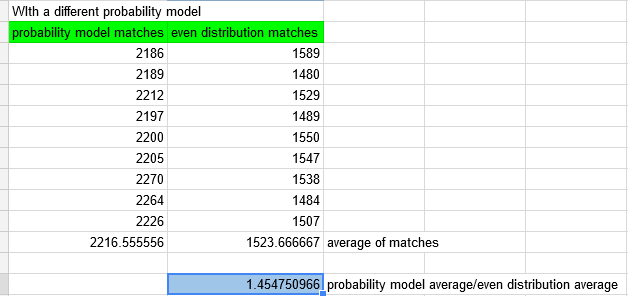
Since our theoryTest.txt has 7 numbers defined and we're only choosing 2 numbers the odds of getting a match of both numbers is 1/(7!/2!/5!) = 1/(5040/120/2) = 1/21 ~ 0.047619
0.047619 * 32000 = 1523.808
So out of 32000 draws we should have about 1524 matches.
Here's an excel sheet of actual test results.

By using the defined probability model in theoryTest.txt as an example, we've made a 4.65% increase in our odds of having a match.
I have observed that the more biased (the more uneven the distribution is), the better the probability model quick pick works while the even distribution quick pick stays about the same. Here's an observation on a probability model that is much more biased.
update:
bought another 6 lines of 6/49 (using past year's data) and won nothing so my winning odds are now 2/18
 Login
Login Register
 Tweets
 FAQ
FAQ Advanced Search